

How to calculate your 1RM?
Calculating your 1RM (one-rep max) is one of the simplest hacks to stop training "by feel."
Because once you know your 1RM, you can:
-
choose your loads to the nearest % (strength, hypertrophy, endurance)
-
track your progress correctly
-
and above all, load intelligently on the movements that matter (squats, bench presses, etc.)
In this article, you will learn a reliable method for estimating your 1RM!
Let's go 🔥
What is 1RM?
The 1RM (one-repetition maximum) is the heaviest weight you can lift once, using proper technique and a full range of motion.
The problem?
Many people "calculate" their 1RM using a random formula... based on a set that is not at all representative... and end up with a useless (or even dangerous) number.
Why is it useful?
-
This is an objective basis for calculating your training loads as a percentage of 1RM.
-
you can track your progress
-
you plan your cycles better (strength → volume → intensification)
Method 1: Estimate your 1RM based on one set

The simple protocol
-
Choose a multi-joint movement (bench press, squat, deadlift, etc.).
-
Then do 1 reference set:
-
between 3 and 10 repetitions
-
close to failure (while maintaining good technique)
-
-
Calculate using an appropriate formula (see below).
The formulas to use
You don't need to use a lot. In practice,two are enough:
-
Epley:
1RM = load × (1 + reps/30) -
Brzycki:
1RM = load × 36 / (37 − reps)
Which formula should you choose based on your reps?
| If your set is... | Recommended formula | Why | Avoid if… |
|---|---|---|---|
| 2-5 reps | Epley | Often stable when close to your max | You did a poorly executed rep. |
| 6-10 reps | Brzycki | Widely used for moderate set | You have high muscular endurance (you can easily do 10 reps, but your actual 1RM is lower). |
Complete example
You do 8 reps at 80 kg on the bench press, with clean form.
-
Epley: 1RM = 80 × (1 + 8/30) = 80 × (1 + 0.2667) = 80 × 1.2667 ≈ 101.3 kg
-
Brzycki: 1RM = 80 × 36/(37−8) = 80 × 36/29 = 80 × 1.2414 ≈ 99.3 kg
➡️ Your "useful" 1RM ≈ 100 kg (rounded).
And you can program your loads as a percentage.
Method 2: Test your true 1RM

Simple protocol
-
General + specific warm-up
-
Then several short sets, increasing the load
-
2-3 "serious" attempts max (otherwise you'll tire yourself out and underperform)
If you are testing your bench press, do not do it alone without safety measures or a spotter.
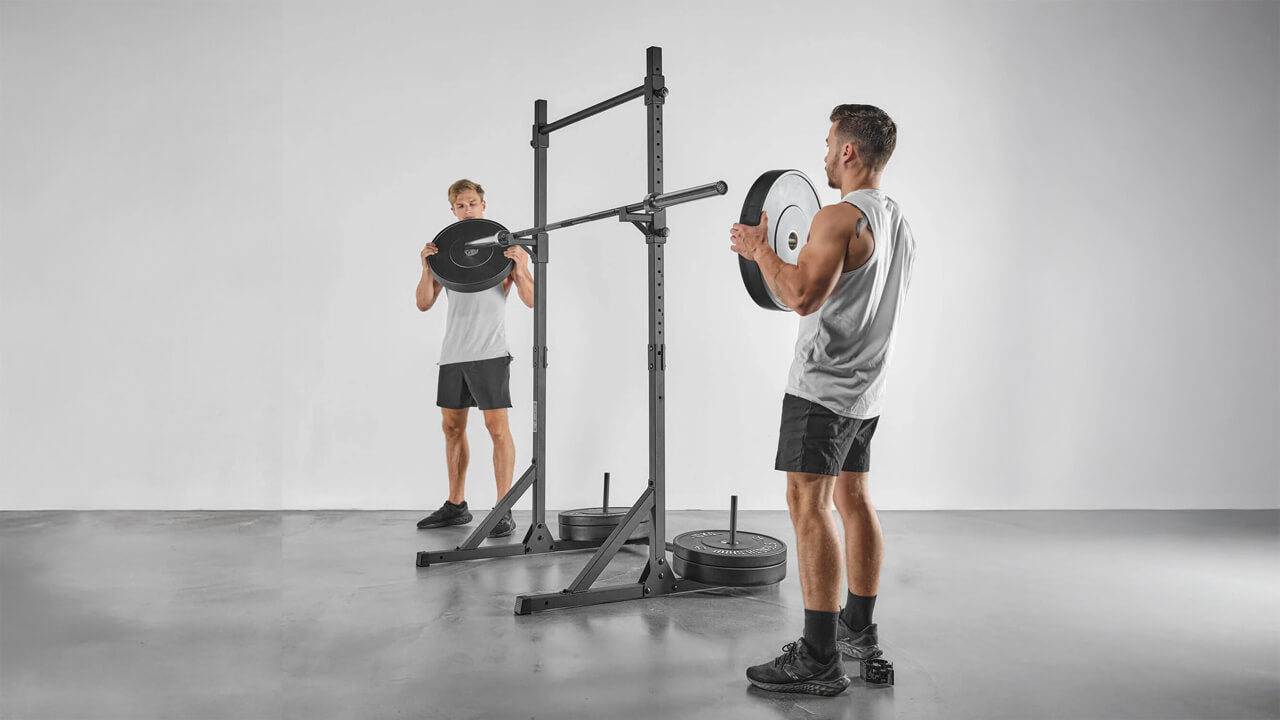
At home: having high-quality equipment is essential. A stable setup that can be upgraded to "rack" mode allows you to load heavier with more confidence.
Our standing pull-up bar + bar supports are designed to transform your setup into a more complete home gym (bench, squat, etc.).
1RM: what weights should you use?
| Objective | % of 1RM (reference) | Typical rep zone | How to use it |
|---|---|---|---|
| Strength | 85-95% | 2-5 reps | Short sets, long rest periods, strict technique |
| Hypertrophy | 70-80% | 6-12 reps | Perfect for progressing and building volume |
Tip: For many people, "classic" hypertrophy often falls around 70-80% of 1RM.
The 8 mistakes that skew your 1RM (and how to avoid them)
-
Set not representative (too easy/too far from failure) → aim for a tough, clean set.
-
Changing technique (bench bounce, shortened squat) → same range of motion, same tempo.
-
Too many reps (15-20+) → use a range, not a single number.
-
Exercise too "isolating" → formulas are more reliable on compound movements.
-
Fatigue/lack of sleep → your "daily" 1RM ≠ your actual level.
-
Sloppy warm-up → poor performance and high risk.
-
Week-to-week comparison under different conditions → compares similar sets.
-
Wanting a perfect figure → aims for a useful estimate for programming.
FAQ :
Which formula is the most reliable for calculating your 1RM?
For most people who work out: Epley (1-5 reps) and Brzycki (6-10 reps) cover 95% of needs.
How many repetitions can I use to estimate my 1RM?
Beyond 10-12 reps, the formulas diverge more. The best option is to stay between 3 and 10 reps.
Why does my 1RM vary from day to day?
Sleep, stress, nutrition, warm-up, motivation, and above all: technical quality. Always compare similar conditions (same exercise, same range of motion, etc.).
How often should you recalculate your 1RM?
It is a good idea to do this at the end of a block (e.g., every 6 to 12 weeks).
How can I use my 1RM to build muscle?
Set your main sets at around 70-80% of your 1RM, build up volume, increase reps or weight, and maintain strict form.
I hope you enjoyed this article!
Feel free to comment and share it if you do.
See you soon.
Eric Flag

%20c%E2%80%99est%20l%E2%80%99un%20des%20hacks%20les%20plus%20simples%20pour%20arr%C3%AAter%20de%20t%E2%80%99entra%C3%AEner%20%E2%80%9Cau%20feeling%E2%80%9D.%0AParce%20qu%E2%80%99une%20fois%20que%20tu%20connais%20ton%201RM,%20tu%20peux%20:%0A%0A%0Achoisir%20tes%20charges%20a...)
Leave a comment
This site is protected by hCaptcha, and hCaptcha's Privacy Policy and Terms of Service apply.