

Bodyweight Training: Progress SUPER FAST at home!
Hey there! 😃
Welcome to this new article!
After showing you how to master your push-ups like a pro, today I'm going to explain how to quickly progress in bodyweight training right at home 🔥
Whether you're looking to master a challenging move or string together more reps of an exercise you already know, whether it's for personal enjoyment or to ace a fitness test, you've come to the right place 💪
In this article, I'm going to show you a simple and super effective method to improve, one you can use every day, anywhere.
This method, known as Greasing the Groove, was revealed to me about 10 years ago in a book by Pavel Tsatsouline, and I've used it successfully many times since.
Progressing in bodyweight training:
The "GREASE THE GROOVE" method
It's a known fact: the more you repeat a movement, the stronger your neuromuscular connection becomes. Your brain then learns to control your body and muscles better, just like when you're learning to play the piano.
What's less obvious is that strength works the same way. By treating it like a technical skill, you can improve it quickly.
Your body needs to recover from its efforts. For example, 30 seconds of pull-ups requires more recovery than 30 seconds of piano.
This method is perfect for training both technique and strength. It's great for progressing on exercises where you can only do a few reps, and it's also effective for boosting your muscle endurance on longer sets.

Basically, this method involves doing as many reps as possible for a chosen exercise within a specific time.
You spread these reps across several sets, with plenty of rest between each set, without interfering with your regular training schedule.
Bodyweight Training: The Key Numbers
Compound exercises are where this method works best. This includes all classic strength training exercises, but the best options will probably be bodyweight exercises and those for which you often have the necessary equipment on hand.

Also, you should already be able to do at least 3 full reps in a row for the exercise you want, or hold an isometric move for 3 or 4 seconds.


You get it, it's crucial to avoid failure and fatigue in every set. Do your sets at 40-60% of your maximum time or reps, which you'll need to test beforehand.
Test your new max every 2 weeks to adjust your sets, or gradually increase them based on how you feel. Only do perfect reps to really solidify the technique.
Pick only one exercise at a time for this method. If you want to do two, aim for different muscle groups or goals and alternate between them on the same day or every other day, to avoid overtraining.

For this method, you need to be completely fresh before each set, which means you'll need long rest times. The minimum recommended rest is 15 minutes, but it depends on the exercise and the effort you put in. The longer your sets or the more advanced the exercises, the longer your rest should be.
Personally, I take 30 to 45 minutes of rest just to be sure.
A quick note on warming up:
Ideally, pick exercises that don't require much warming up so you don't waste too much time. It depends on you and your situation. Either warm up your important joints just enough, or find a way to work around these issues.
For example, I can't do Handstands or Planches on the floor without warming up because it hurts my wrists.

But it's no longer a problem when I do them cold on wooden parallettes!

Weekly Structure
The goal of the GTG (Grease the Groove) method is to complement your normal workouts, not to replace them or negatively impact them.
It's perfect for your rest days, as long as it doesn't stop you from recovering enough to be fresh for your usual workouts. On training days, I don't recommend this method if your workout targets the same muscle groups as the chosen exercise.

If not, still limit the method to avoid fatigue. Even if you can do it every day, take one full rest day per week or whenever you feel you need it.
As for the chosen exercise, you can change it whenever you want, but I recommend practicing it for at least 2 to 3 consecutive weeks and seeing a measurable improvement in your maximum before moving on to another.
Improve Your Pull-ups in Bodyweight Training
Let me give you some concrete examples. Let's say you want to get better at pull-ups.
First step: know your current max. Imagine you can do 9. So, you'll aim for sets of 4 or 5 reps, doing them several times throughout the day, with at least 30 minutes of rest between each set.
Keep this up for several weeks, avoiding back and pulling workouts. Then, either add a rep to your sets based on how you feel, or test your maximum from time to time at the start of the day to adjust your sets accordingly.


Just like with your regular workouts, I strongly recommend keeping a written record of all this, whether it's in a small notebook or simply in your phone's notes.
Get Your First Pull-up
For another example, you can use this method to learn how to do your first pull-up, which is a complex bodyweight exercise. It will be very effective and fast for that.
Since your brain isn't quite familiar with this movement yet, do sets of negative pull-ups throughout your day. Either base it on your maximum reps for 2 or 3 controlled seconds and do sets of a few negatives, or base it on your maximum controlled descent time and do sets of a single rep at 50% of your max time.
You can also train with resistance bands.

Improving Your Advanced Moves
Personally, I use this method on my Calisthenics Bar to strengthen my Front Lever. With a maximum hold of 5 seconds, I do sets of 2 or 3 seconds throughout the day. This method is very effective for mastering this move.
You can also use this method to improve your hold time on any skill progression, even if you're using a resistance band for assistance.
Personally, I like working with a band because it lets me get more time under tension in the final position. This way, I can do longer sets, which are easier to track and count in my head than just 2 or 3-second holds.

How to Use the GTG Method Every Day
To wrap things up, here's how you can easily fit this method into your daily routine.
Turn it into a habit. Link it to a regular activity, like doing a set every time you pass your pull-up bar or during breaks at work.
Another effective method is to set a countdown timer on your phone. Every time it goes off, do a set.
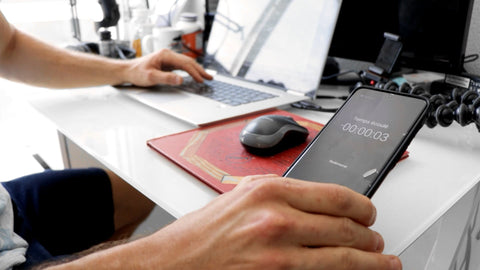
This method is all about volume, aiming to rack up more reps and time under tension without affecting your main workouts or your recovery.
Use it flexibly. No need to hit X sets or reps, and don't feel guilty if you miss a day. It's an extra tool to help you get better, without demanding a ton of physical or mental effort all at once.
Here's the practical guide:

I hope you enjoyed this article and that it helps you progress in bodyweight training!
If you need any sports equipment, you can find everything on my shop 🔥
In the meantime, take care 💪
Eric Flag




Leave a comment
This site is protected by hCaptcha, and hCaptcha's Privacy Policy and Terms of Service apply.