
Mastering impossible Calisthenics moves!
Hello there!
Welcome to this new article, which follows the one presenting the different Street Workout moves, from the most accessible to the most impossible.
We will cover the different methods that will help you gradually achieve all the moves we're about to see 💪
Let's get started learning Calisthenics!
Unilateral exercises, slowly but surely!
First method: You can gradually make exercises unilateral, meaning gently relying less on one arm or leg. This method is especially useful for beginners to progress in basic exercises like push-ups, pull-ups, and squats.
You can start by doing them in archer style to put more weight on one side, then you can use your second limb to assist the first less and less.

This can be by gradually removing fingers or holding onto an external object at different heights. For pull-ups, you can also hold onto your own body or even use a pulley and counterweight system to work your way up to a one-arm pull-up.
Learning Calisthenics: Adjusting the height of your support points
Second method: You can adjust the height of your support points, especially when exercises require you to place at least one hand and one foot somewhere, which is the case for all floor push-ups, horizontal rows, and stand-ups, for example.
It simply involves elevating your hands or feet to make an exercise more or less challenging.
For example, to make push-ups harder, you can elevate your feet. Conversely, elevating your hands will make this exercise easier.
Varying your support to increase strength
Thirdly: You can vary the supports and grips to change the difficulty of an exercise.
For example, you can perform dips in different ways: on straight bars, parallel bars, or even on gymnastic rings.
Adding weight in Calisthenics: guaranteed progress
Fourth method: Adding external weights to progress You can equip yourself with a dip belt or a weighted vest, for example, which are two essential tools to significantly boost your performance.
Adding more and more weight to these exercises is a great way to boost your strength and muscle endurance. For instance, weighted pull-ups are among the best exercises to do when you're aiming for a one-arm pull-up or just want to do more pull-ups in a row.
Improve your Calisthenics: Play with your body's leverage!
Fifth method, certainly the most well-known: You can adjust your body's leverage by bending and bringing one or two legs closer to the anchor point.
This is often recommended for main skills like the Back Lever, the Front Lever, the Human Flag, and the Planche.
The standard progressions are the Tuck, the Advanced Tuck, the One Leg, the Straddle and the Full.


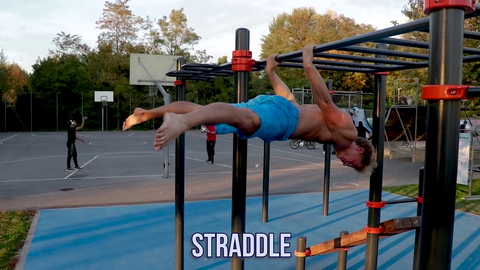

There's an almost unlimited number of progressions between each of these, so don't hesitate to try out your ideas.
Next, a well-known and highly effective method is to assist yourself with an elastic band.
You can modulate the difficulty by choosing the resistance of the bands, and by pulling them more or less.
Flexibility and mobility, your best allies!
It's pretty obvious, but working and improving your flexibility and mobility will pay off just about everywhere, and especially for :
- The V-Sit.
- Straddle progressions.
- The Handstand and its variants.
To perfect your skills in these exercises, we offer you products that will meet your expectations, such as wooden parallettes through to bars dipsyou'll find everything you need in our our store !
Concentric training, what is it?
You don't need endless exercises to learn the main moves!
Think about doing concentric work, i.e. doing repetitions and eccentric work: negative repetitionsor slowly holding the descent.
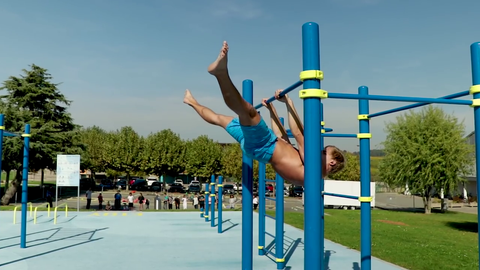 Negative Front lever
You can also apply these tips to exercises that are not primarily strength-based, looking for variations or accessory exercises that will transfer their progress to the final figure.
Repetition amplitude, a determining factor for progress in Callisthenics
Finally, it's a good idea to play with the amplitude of the repetitions. Whether you're doing relevés or negatives, stop before you reach the most difficult point, where the body is horizontal.
Feel free to comment on this article if you enjoyed it!
See you soon,
Eric Flag



Leave a comment
This site is protected by hCaptcha, and hCaptcha's Privacy Policy and Terms of Service apply.